
Mastercard doesn’t bill you directly for the four new fees hitting specialty merchants this year. It bills your acquirer. That distinction matters less than you’d hope, because the cost doesn’t stop at the acquirer — it moves downstream, onto your statement, the same way every network fee eventually does.
On October 28, 2025, Mastercard published l an overhaul of its Specialty Merchant Registration Program. It raises an existing high risk registration fee, and introduces two entirely new per-transaction charges on every specialty merchant transaction. These are equivalent to the new fees introduced by VISA’s VIRP a couple of years ago. If you are a high-risk merchant, this new program will apply for all your Mastercard transactions across the board.
Here’s exactly what changed, what it costs at different volumes, how it stacks up against Visa’s equivalent program, and what to check before the next line item shows up on your statement.
What Changed, and When
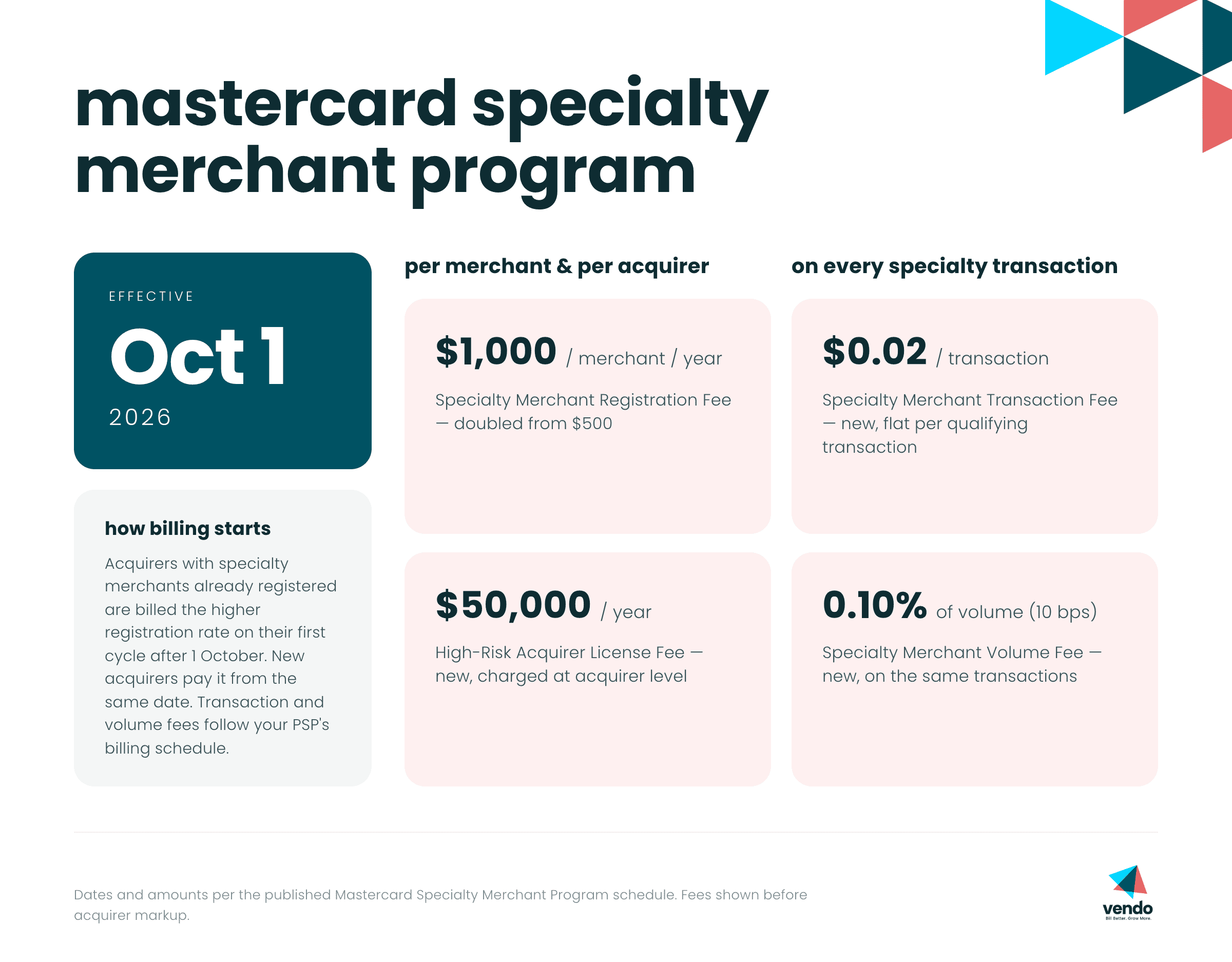
Effective October 1st 2026:
There is no phase-in and no grace period. Acquirers that already had specialty merchants registered will be billed the higher registration rate on their first cycle after October 1st. Acquirers registering specialty merchants for the first time pay the higher rate from the same date.
The Three New Charges, Explained
Specialty Merchant Registration Fee. This existing fee doubled from $500 to $1,000 per registered merchant, per year — a straightforward increase, not a new charge.
Specialty Merchant Transaction Fee. A flat $0.02 charged on qualifying transactions, billed according to your PSP’s billing schedule.
Specialty Merchant Volume Fee. Ten basis points (0.10%) of transaction volume, also billed according to your PSP’s billing schedule.
The two per-transaction fees stack on top of whatever you already pay — interchange, network assessments, and any premium built into your existing high-risk pricing. Neither is waived or reduced for merchants with clean chargeback histories; the fee applies to the transaction category, not to the merchant’s track record.
How Mastercard Identifies a “Specialty” Transaction
The mechanism is a Transaction Type Identifier, or TTI — a code attached to a transaction at the network layer that tells Mastercard’s systems what kind of merchant generated it. Four TTIs matter here:
- P70 and P76 — cryptocurrency
- P71 — high-risk securities
- P72 — the catchall for everything else in the specialty program, including adult content, dating, and nutraceuticals
The fees apply specifically to processing codes for standard purchases, purchases with cash back, unique transactions, and credits. Funding transactions are exempt. Once a transaction carries a P72 tag, the fee applies — there’s no MCC workaround, and recoding a transaction to dodge the tag isn’t an available option.
One detail worth sitting with: crypto and securities each got their own dedicated TTI, separating them from the rest of the specialty pool. Adult, dating, nutra, and subscription-heavy businesses all share the P72 bucket — meaning if Mastercard adds another vertical to the specialty program in the future, businesses already in P72 absorb that fee exposure too, without any change to their own operations.
What It Costs: Three Scenarios
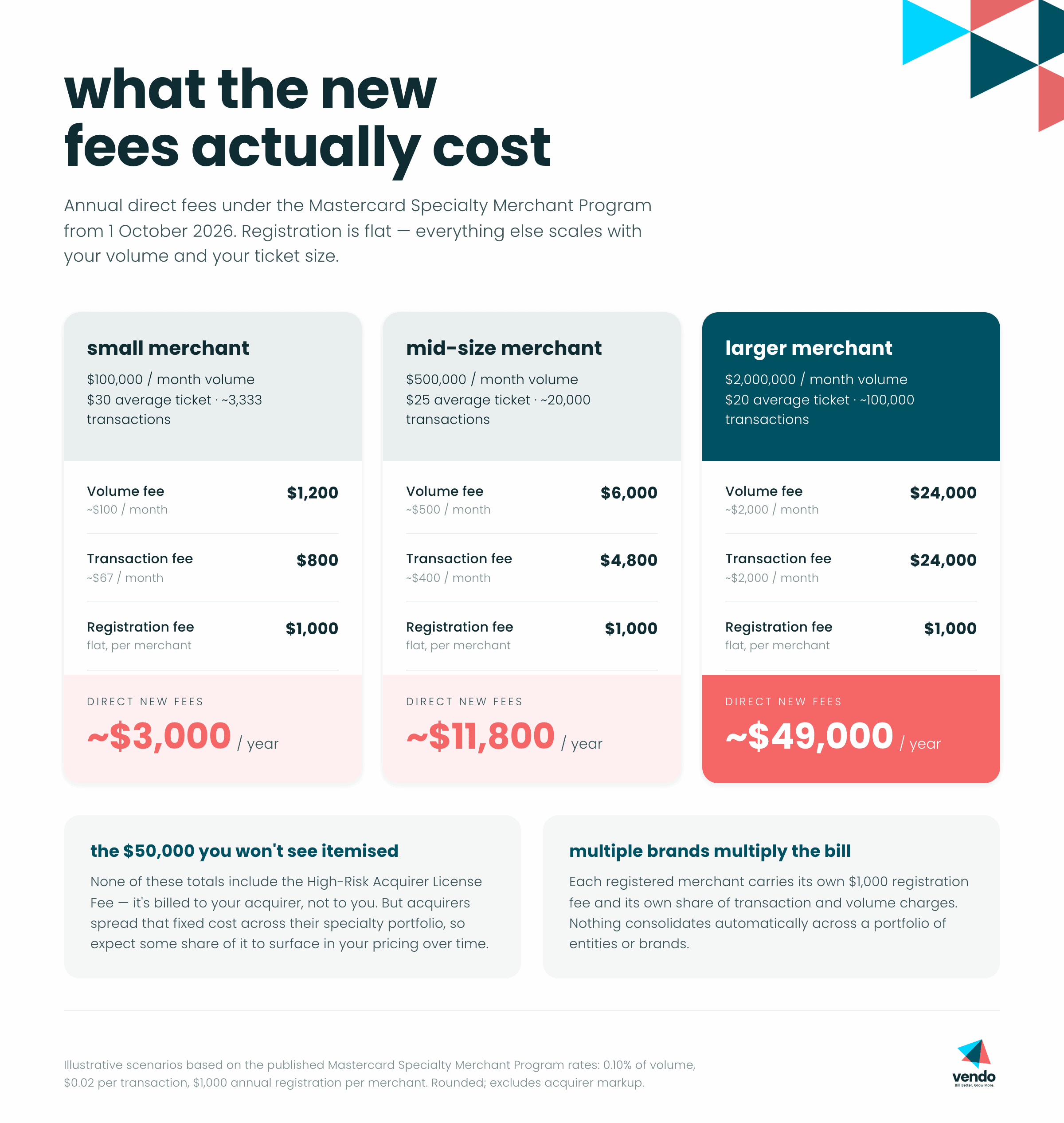
These are illustrative models based on the published fee schedule, not projections for any real merchant. Run your own transaction count and average ticket through the same math to get your figure.
How This Compares to Visa’s Integrity Risk Program
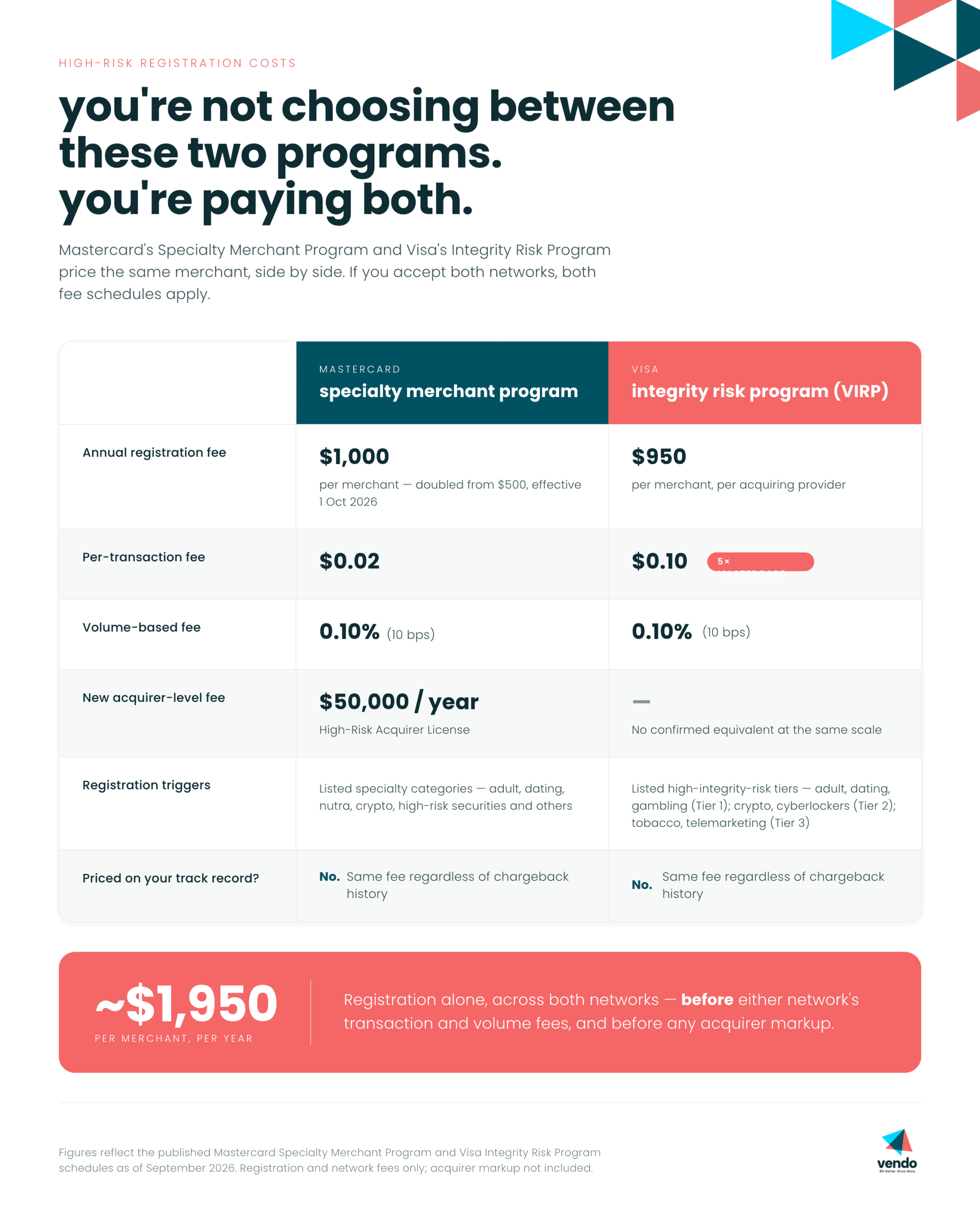
If you accept both networks — standard for most adult and subscription platforms — you’re not choosing between these costs. You’re paying both.
Combined, registration alone runs close to $1,950 per merchant per year across both networks — before either network’s transaction and volume fees, and before any acquirer markup. Visa’s per-transaction fee is five times Mastercard’s; Mastercard’s new acquirer license fee has no confirmed Visa equivalent at the same scale. Neither network ties its fee to your chargeback rate or processing history — both charge the same amount whether you’ve run a clean book for five years or you’re new to the program.
Why Adult and Subscription Merchants Feel This More
High-risk registration fees have always applied more heavily to specific verticals — but this overhaul doesn’t change who’s exposed, it deepens it. Adult, dating, nutra, and subscription-heavy businesses were already paying a premium to keep card acceptance: elevated discount rates, larger reserves, and stricter chargeback thresholds than a standard e-commerce merchant. These new fees don’t replace any of that pricing — they layer on top of it.
For subscription businesses specifically, the per-transaction and volume fees hit differently than they would for a merchant with a high average ticket. A $0.02 fee and a 10-basis-point charge barely register against a $200 order. Against a $9.99 monthly renewal, they’re a meaningfully larger share of the transaction — and subscription platforms process renewal transactions at high frequency, which is exactly what the volume fee is built to capture.