

A practical explainer for companies working in high-risk domain and living under tighter payment scrutiny — what network tokens improve, what they leave untouched, and what to ask a payment provider.
A loyal customer signs up for a monthly service and uses the same card for a year. Then the bank replaces that card after a suspected breach. The customer still wants the service. The merchant still has permission to charge. Yet the next renewal fails because the stored card number has gone stale.
That small break in the payment chain can trigger retries, dunning emails and support tickets. Eventually, it can turn a willing customer into involuntary churn. High-risk merchants feel the damage sooner because they often combine recurring billing, cross-border traffic and stricter acquiring rules.
Network tokenization gives the payment system a better credential to work with. It can keep legitimate payments alive after a card changes. It can also give issuers richer security signals. However, it cannot settle a billing dispute or repair a confusing cancellation flow.
What Is Network Tokenization?
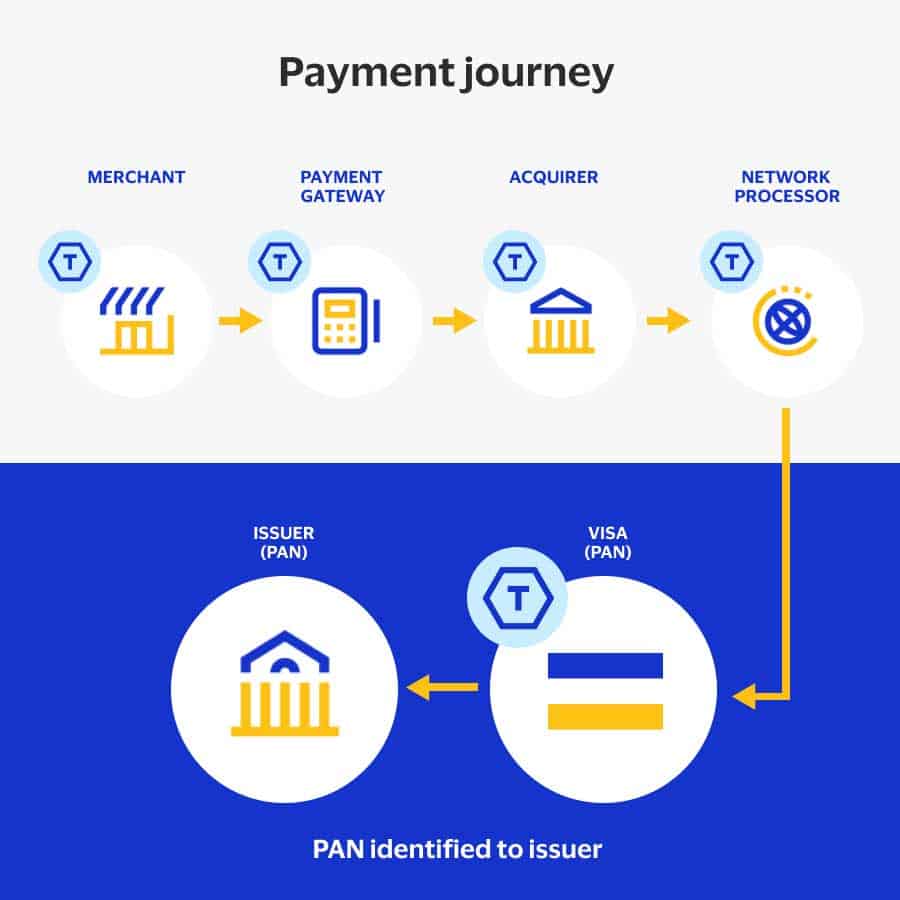
Network tokenization replaces a card’s primary account number, or PAN, with a payment token issued through a card network. Visa, Mastercard and American Express operate token services, while the card issuer approves the token request.
The token usually works only within a defined domain, such as one merchant or one device. A stolen PAN can travel widely. A properly configured network token has far less value outside its approved setting.
For many customer-initiated payments, the transaction also carries a one-time cryptogram. Adyen describes that cryptogram as contextual to the merchant, token and purchase. Together, those controls help the issuer judge who requested the payment and where the credential belongs.
The customer rarely sees any of this. At checkout, they still enter a card or choose a saved payment method. Behind the screen, the merchant or its payment provider asks the network to provision a token. Future transactions can then use that token instead of repeatedly sending the PAN.
Lifecycle management adds the commercial benefit. When an issuer renews, replaces or suspends the underlying card, it can update the token’s status. Therefore, a valid subscription may continue without asking the customer to type in a new card number.
Network Tokenization vs Gateway Tokenization
Merchants often say “tokenization” when they mean two different systems.
A gateway or PSP token replaces a PAN inside one provider’s vault. The provider converts that token back into card data when the payment must travel through the wider card system. This arrangement limits the merchant’s exposure to card data, but the token may stop working when the merchant changes providers.
↳ A network token travels through the payment chain as the payment credential.
↳ The network and issuer recognize it, manage its lifecycle and apply domain controls.
↳ The issuer sees more context than it would receive from a basic vault reference.
Both systems can coexist. In fact, a merchant may hold a provider token that maps to a network token behind the scenes. The operational question concerns control: can the merchant use the credential across its chosen processors, or does one provider own the route?
Network tokens can support processor flexibility, but only when the commercial agreement and technical design allow it. A “network token enabled” box on a sales deck does not answer that question.
Why Network Tokenization Matters More in High-Risk Payments
Acquirers classify merchants as high risk for several reasons. The industry may attract more fraud or disputes. The business may sell subscriptions, digital goods or regulated services. It may also process internationally or face higher refund and chargeback volatility. (For more on how that classification works and what it costs, see our breakdown of Visa and Mastercard high-risk fees and VIRP tiers.)
These merchants have less room for noisy payment data. A false decline can remove good revenue. A fraudulent approval can create a loss and later become a dispute. Meanwhile, repeated billing failures can push teams toward aggressive retries that annoy customers and add cost.
Payment tokenization for high-risk merchants improves one part of that equation: the quality and continuity of the credential.
1. More legitimate transactions can reach approval
Issuers must decide within seconds whether to approve a payment. A domain-bound token, current lifecycle status and cryptogram give them stronger signals than a static card number alone.
Public results vary by provider, geography, issuer mix and transaction type. Visa reports a 4.6% global authorization lift for tokenized card-not-present transactions compared with PAN transactions. Adyen reports an average 3% uplift among businesses on its platform. More recently, Mastercard and Checkout.com reported a 10.3 percentage-point approval difference for a selected 2025 dataset, after excluding financial declines.
Those figures do not promise the same result for every merchant. They use different populations and methods. Still, the direction appears consistent: network tokens can help issuers approve more valid payments.
For a high-risk merchant, even a modest gain matters. Better approvals produce more revenue from traffic the merchant already acquired. They may also reduce the temptation to hammer failed cards with poorly timed retries.
2. Recurring payments lose fewer customers to stale cards
Network tokenization for recurring payments addresses a dull but expensive failure: an outdated credential.
Consider a paid community with monthly billing. A member’s bank replaces her card after fraudulent activity at another store. A stored PAN may fail at renewal. By contrast, a network token can receive a lifecycle update and remain connected to the new credential.
The member keeps access. The merchant avoids a retry sequence. Support does not need to chase a customer who never intended to leave.
Network tokens do not remove every decline. An issuer may still reject a charge for insufficient funds, a closed account, a regulatory block or suspected fraud. Merchants still need sensible retry logic, clear stored-credential indicators and compliant merchant-initiated transaction flows.
3. Stolen credentials become harder to reuse
Here is how network tokenization reduces payment fraud: it limits where a credential works and pairs it with transaction-specific security data.
EMVCo explains that payment tokenization constrains a token to a merchant, device or payment scenario. Consequently, criminals gain less from stealing a token database than from stealing reusable PANs. Visa’s public research reports about 30% lower online fraud for token-based transactions than for PAN transactions.
Again, averages need context. Tokenized and PAN traffic may differ in customer behavior, issuer participation and authentication. Merchants should test performance against a comparable control group rather than paste an industry average into a revenue forecast.
What Network Tokens Will Not Fix
Network tokenization helps protect card credentials. It does not make a high-risk business low risk.
First, it cannot prevent friendly fraud. A customer can recognize a payment technically and still dispute it because they forgot the purchase, dislike the product or could not cancel easily.
Second, it cannot correct unclear descriptors, hidden rebills or weak customer service. Those problems often drive disputes even when the cardholder authorized the original transaction.
Third, it cannot replace fraud screening or 3D Secure. Tokenization protects the credential layer. Fraud tools assess the transaction and customer behavior, while 3D Secure lets the issuer authenticate the payer. Merchants need those controls to work together.
Finally, it does not guarantee lower chargebacks. Lower credential fraud may reduce one source of disputes. Yet first-party misuse, service complaints and refund friction can keep the overall dispute rate high.
This limit deserves emphasis because high-risk operators often search for a direct line from network tokens to chargeback compliance. The line bends through customer experience, billing practices, authentication and post-purchase support.
The Implementation Questions Merchants Keep Asking
Public discussions about network tokens tend to circle around practical control rather than the basic definition. Merchants want to know who provisions the token, who pays for it, what happens during a PSP migration, and whether the provider exposes performance data.
Before signing a contract, ask:
- Which networks, issuers, countries and transaction types do you support? Coverage can vary across Visa, Mastercard, American Express and domestic schemes.
- Do you provision tokens for existing cards on file as well as new cards? A feature that covers only new checkout traffic leaves the old vault untouched.
- Who acts as the token requestor? The answer affects control, reporting, domain restrictions and migration.
- Can we move or reuse tokens if we add another PSP? Request the migration process, timelines, fees and failure plan in writing. (If you’re weighing a processor switch, see our notes on what actually changes when you move on from a provider like Stripe.)
- How do you handle lifecycle events? Ask about card replacement, expiry, account closure, token suspension and deletion.
- Can you route between a network token and PAN when an issuer performs better on one credential? Stripe and Adyen both describe optimization that chooses the stronger route in context.
- How do you generate cryptograms for customer-initiated and merchant-initiated payments? The flow must match the payment type and network rules.
- What do your reports show? At minimum, merchants need token coverage, provisioning success, authorization results, decline reasons, fraud and disputes.
- What fees apply? Separate provisioning, lifecycle, transaction and scheme costs. Then compare them with measured approval gains.
- What stays in PCI scope? Ask for a data-flow diagram and validate the answer with your own compliance adviser.
Vendo specializes in high-risk payment processing for adult, CBD, seeds, and other high-risk industries. Our solutions are tailored to meet the unique needs of your business, ensuring seamless transactions and reducing the risk of payment disruptions. Contact our expert team to learn how we can help your business to maximize growth during the festive holidays and beyond.